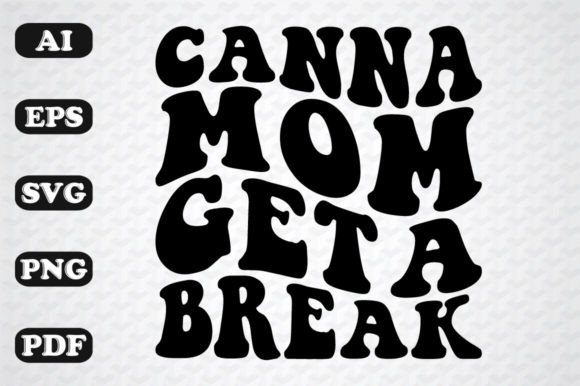
Canna Mom Get a Break
A Retro Wavy Vibe That Feels Like a Deep Breath
First glance at Canna Mom Get a Break lands like a warm, slightly sassy exhale—soft curves, playful rhythm, and that unmistakable 70s-inspired wavy line work. It’s not shouting; it’s leaning back in a lounge chair with sunglasses on. As an embroidery designer who’s stitched hundreds of text-based designs for real clients—from boutique baby boutiques to Etsy shops selling custom sweatshirts—I immediately read this as a *personality-first* design. It leans into humor and humanity without tipping into irony or exhaustion. That matters. When you’re stitching something meant to be worn, held, or gifted, tone is texture—and Canna Mom Get a Break has just the right grain.
How It Lives Off the Screen and Onto Real Things
Last week, I prepped a small-batch run of organic cotton tote bags for a local mom-owned café. We needed something light but grounded—no clichés, no forced whimsy. Canna Mom Get a Break landed perfectly on the front left chest: 3.2” wide, soft satin-stitched outlines, gentle fill areas, and just enough curve to follow the natural drape of the fabric. No puckering. No thread nesting. The wavy baseline gave subtle movement—even static, it felt alive. Customers didn’t just smile; they paused, read it aloud, and asked where to buy one. That’s the quiet power of a well-considered machine embroidery design: it invites connection before anyone even touches the item.
It shines brightest on mid-weight fabrics where stitch definition holds—think structured sweatshirts, canvas aprons, linen pillow covers, or loopback cotton tea towels. On a heavyweight hoodie? Yes—especially with a tear-away + cutaway stabilizer combo. On a lightweight rayon blend tee? Proceed with caution: reduce stitch density if converting to embroidery (more on that below), and always test on scrap first. The curves are generous, not tight—so it avoids the “crowded corner” trap many retro fonts fall into. That makes it unusually forgiving for embroidered patch applications too, especially when fused onto denim jackets or backpacks.
Where It Fits—and Where It Needs a Pause
Canna Mom Get a Break isn’t built for micro-hoops or baby onesies under 2”. The letterforms have breathing room—not tiny serifs or hairline details—so it scales down cleanly to about 2.5”, but anything smaller risks losing its laid-back charm. Avoid dense applique builds here; this design thrives as a clean, single-layer embroidery file, not a multi-step build. For caps or curved surfaces, keep placement above the bill seam and use a low-profile bobbin thread—those waves respond beautifully to gentle contouring, but won’t forgive aggressive stretching.
Dark fabric? Absolutely works—just choose high-contrast thread (navy on cream, charcoal on heather grey, or even mustard on black). Light fabric? Crisp white or oat thread keeps it airy. And yes—it reads clearly on textured weaves like terry cloth or waffle-knit towels, as long as your stabilizer bridges the gaps evenly. What *doesn’t* serve it well: ultra-thin silks, heavily brushed fleece (unless stabilized aggressively), or garments meant for daily machine washing *without* turning inside out. The wavy lines hold up, but delicate satin stitches need care—this is a handmade product, not fast fashion.
What It Adds to Your Craft Business—Beyond the Stitch
For Etsy sellers and small shop owners, Canna Mom Get a Break is quietly strategic. It’s niche-specific without being exclusionary—mothers, plant lovers, wellness-adjacent audiences, and anyone who values gentle rebellion all recognize themselves in it. That translates directly to higher perceived value on a finished product. A $38 embroidered sweatshirt feels intentional, not generic—because the design does the emotional lifting. It also photographs exceptionally well in natural light mockups, which means stronger listings, better social thumbnails, and less time editing.
As a digital product seller, it’s a smart addition to a “mom life” bundle—but only if your license permits commercial use. Since the listing notes it’s an Svg t-shirt design with AI files included, confirm whether the license covers resale of stitched items *and* redistribution of the vector file itself. Clarity there protects your craft business and builds trust with buyers who want to know exactly what they’re getting.
Practical Designer Notes Before You Stitch
- Always test on scrap fabric—same weight, same wash history, same stabilizer combo you’ll use for the final piece.
- Check thread color contrast in both daylight and indoor lighting. What pops at noon may disappear under cafe pendant lights.
- Review stitch density if converting from SVG to embroidery format. Retro wavy lines often benefit from slightly looser fills to preserve flow.
- Confirm hoop size compatibility—the design’s width and height should comfortably fit within your most-used hoop, with ¼” margin.
- Inspect small details visually *and* by hand: run your finger over the stitched sample. Does the wave feel smooth? Or snaggy? Adjust tension if needed.
- Test black-and-white mockups—they reveal hierarchy and legibility faster than color.
- Compare light/dark backgrounds using physical swatches, not just screen previews.
- Use proper stabilizer: medium-cutaway for knits, tear-away + light cutaway for stable wovens, fusible for patches.
- Verify dual-use suitability: will this work equally well for a personalized gift *and* a wholesale boutique order? Canna Mom Get a Break passes that test.
- Confirm licensing terms before listing on Etsy, adding to a digital shop, or offering as part of a subscription bundle.
Final Thought: It’s Not Just a Design—It’s Permission
In a world full of “busy mom” tropes and performative productivity, Canna Mom Get a Break offers something rare: visual empathy. It doesn’t ask for applause. It asks for pause. That’s why it works so well on slow-living products—kitchen towels folded beside a coffee maker, pillow covers on a sunlit reading nook, or a simple embroidered patch sewn onto a child’s backpack. It’s not loud. It’s anchored. And for designers, makers, and small business owners building meaningful handmade products, that kind of quiet resonance is worth more than any trend. Use it thoughtfully, stitch it with care, and let the wave carry the weight.