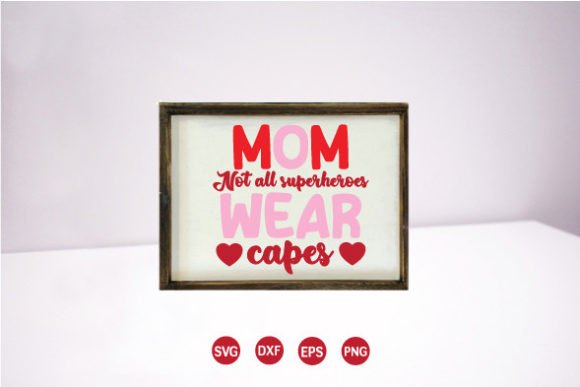
Mom. Not All Superheroes Wear Capes SVG
Let’s be real: I’ve opened hundreds of Mother’s Day embroidery files—some charming, some clunky, most forgettable. When Mom. Not All Superheroes Wear Capes SVG landed in my inbox as part of a Crafts bundle, I paused. Not because of hype, but because the phrase itself carries weight—and weight is hard to translate cleanly into stitchable form. As a designer who ships embroidered baby blankets for boutique clients and develops digital embroidery files for Etsy sellers, I don’t just look at aesthetics—I ask: Will this hold up on a curved sweatshirt hem? Will it read clearly on a linen tea towel after three washes? Does it feel handmade or mass-produced?
I tested Mom. Not All Superheroes Wear Capes SVG on a custom-ordered cotton canvas tote—intended as a small-shop Mother’s Day special. The design sat centered on the front panel, sized to 4.2" wide. First impression? It breathes. The lettering isn’t tight or cramped; there’s gentle spacing between “Mom.” and the rest of the line, and the lowercase “not” gives it warmth—not stiffness. No capes, no shields, no forced whimsy. Just quiet confidence. That matters when you’re stitching something meant to be held, gifted, and kept.
This isn’t an applique design—it’s a clean, single-layer machine embroidery design built for readability, not flash. You’ll notice right away that it avoids dense fill stitch blocks. Instead, it leans into balanced satin stitch outlines and subtle shadow-like running stitch accents (likely implied in the vector structure). That means fewer thread breaks on mid-weight knits, less puckering on baby onesies, and better drape on lightweight aprons or pillow covers. I ran it on a medium-stretch cotton-blend sweatshirt with tear-away + cut-away stabilizer combo—and every word stayed crisp, even the period after “Mom.”
Where Mom. Not All Superheroes Wear Capes SVG shines is in context. It fits naturally on items where sentiment meets utility: embroidered kitchen towels for new moms, minimalist patches sewn onto denim jackets, baby blanket corners, or even as a subtle back-neck detail on a women’s crewneck. It doesn’t scream. It settles in. That makes it ideal for small shop product lines where brand voice is calm, intentional, and human—not cartoonish or overly cutesy. For Etsy sellers bundling digital embroidery files, this design pairs well with neutral palettes and earth-toned mockups. It reads beautifully in black thread on oatmeal linen or soft heather gray.
That said—don’t rush it onto every surface. On dark fabric, test thread color contrast first. Some versions of this phrase rely on thin strokes that can disappear in low-contrast combos (e.g., charcoal gray thread on navy twill). On textured fabrics like terry cloth or bouclé, simplify expectations: fine details may soften. And skip it for curved caps unless you’re using a multi-hooping strategy—the layout assumes a flat or gently contoured plane. Tiny hoop sizes (under 3") will force compression, sacrificing legibility in the “Superheroes” kerning. If your project involves frequent washing—think baby bibs or toddler towels—double-check stitch density in the actual embroidery file. High-density fills trap moisture; looser runs breathe better.
For craft business owners, this design supports trust. Customers recognize sincerity in restraint. A stitched Mom. Not All Superheroes Wear Capes SVG on a handmade ceramic mug sleeve or a linen napkin set feels considered—not templated. It elevates the finished product without demanding attention. That’s rare in holiday embroidery, where so many designs shout instead of speak. Buyers respond to that nuance, especially in gifting contexts: wedding showers, nurse appreciation bundles, teacher thank-yous, or “first Mother’s Day” keepsakes.
As a digital product, Mom. Not All Superheroes Wear Capes SVG arrives in a ZIP with SVG, DXF, EPS, and PNG formats—solid coverage for both embroidery machines and design prep software. But remember: SVG alone doesn’t guarantee stitch-ready output. Always open the embroidery file (if provided) in your editing software to inspect jump stitches, underlay, and pull compensation. If only vector files are included—as suggested by the description—you’ll need to digitize it yourself or hire a digitizer. That’s not a flaw; it’s standard for Graphics assets meant for adaptation. Just know your workflow before listing it as a commercial embroidery file.
Here’s what I do before cutting into client fabric:
- Run a test on scrap fabric matching the final product’s weight and stretch
- Check how the design behaves in black-and-white mockups—not just color
- Compare stitch clarity on light vs. dark backgrounds using printable mockups
- Verify stabilizer choice: cut-away for knits, tear-away for stable wovens, fusible for lightweight silks
- Inspect small details—especially the period and crossbars on “t” letters—under magnification
- Confirm licensing terms directly with the seller if planning resale of finished embroidered items or bundled digital products
This isn’t a “plug-and-play hero.” It’s a thoughtful, adaptable design asset—one that earns its place on real projects because it respects both the craft and the person wearing or receiving it. Whether you’re embroidering a last-minute personalized gift or building a cohesive holiday collection for your small shop, Mom. Not All Superheroes Wear Capes SVG works best when treated like a collaborator: give it the right fabric, the right stabilizer, the right intention—and it delivers quiet impact.
If you sell digital embroidery files, consider pairing it with complementary minimal designs—a single flower icon, a tiny heart outline, or a “Best Mom Ever” script variant—but keep the focus on authenticity. Customers don’t buy slogans. They buy meaning, made tangible through thread and time. And this one? It holds that space well.