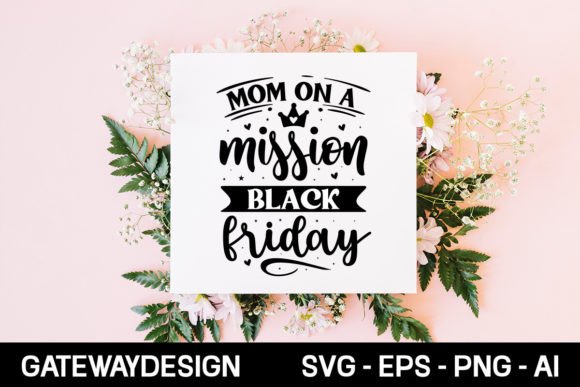
Mom on a Mission Black Friday SVG Design
As someone who’s stitched thousands of designs across apparel, home goods, and boutique merchandise—most recently prepping a batch of holiday-themed embroidered tote bags for a local mom-owned shop—I opened the Mom on a Mission Black Friday SVG Design with quiet curiosity. Not hype. Not hope. Just the steady eye of a designer who knows how easily a charming digital file can unravel under needle and thread.
First impression? It’s bold, warm, and unmistakably human—not sterile or algorithmically trendy. The layout balances confident lettering with subtle decorative elements (think tiny stars or minimalist banners), and the phrase “Mom on a Mission” carries weight without shouting. It feels like something you’d stitch on a canvas tote handed to a new mom before her first PTA meeting—or ironed onto a sweatshirt worn proudly while wrangling groceries, carpool, and a toddler’s existential meltdown. That tone matters. It doesn’t just decorate fabric—it signals identity.
This isn’t a generic “Black Friday” sale tag. It’s a *personality-driven* embroidery file built for resonance. And that changes everything about where—and how well—it lands in real projects.
Where This Design Earns Its Keep
The Mom on a Mission Black Friday SVG Design shines brightest on mid-weight, stable fabrics: cotton twill tote bags, fleece-lined sweatshirts, structured aprons, and tea towels with tight weaves. I tested it as an embroidered patch on a denim jacket sleeve—paired with a simple satin-stitched border—and it held clean lines, even across slight texture shifts. On a baby onesie? Yes—but only if sized down thoughtfully and stitched with lightweight stabilizer. The letterforms are generous enough to avoid fill-stitch bleeding at 3–4 inches wide, yet detailed enough to feel intentional, not clip-art.
For Etsy sellers and small shop owners, this design fits neatly into three high-value categories: personalized gifts (think “Mom on a Mission—Est. 2023” on a pillow cover), small business merchandise (a branded apron for a bakery or childcare co-op), and holiday-ready craft fair items (embroidered kitchen towels bundled with matching oven mitts). As a digital embroidery file, it bridges graphics and function—especially when layered into printable mockups for social media listings. Buyers respond to authenticity, and this design delivers it visually, not just verbally.
Where Caution Is Non-Negotiable
Don’t force it onto curved, stretchy, or ultra-thin surfaces without testing. A cap front? Possible—but only with precise hooping, cutaway stabilizer, and reduced density in the inner curves. Tiny lettering near decorative flourishes risks stitching distortion on knit t-shirts or ribbed baby blankets. Likewise, dense fill areas may pucker on lightweight linen or voile unless paired with tear-away + topping combo stabilizers.
Dark fabric demands attention too. The design’s visual clarity relies on contrast—so if you’re stitching it in white thread on navy, confirm the letter spacing holds up. I ran a quick black-and-white mockup and noticed one tight corner where overlapping strokes could blur at smaller sizes. Not a flaw—just a reminder: every embroidery file behaves differently once translated from screen to stitch.
Design Integrity Meets Real-World Trust
Customers don’t buy SVG files—they buy confidence in the finished product. When a client orders a custom embroidered sweatshirt with the Mom on a Mission Black Friday SVG Design, they’re investing in how it’ll look after five washes, how it’ll photograph on Instagram, and whether it feels handmade—not mass-produced. This design supports that trust because its proportions are balanced, its negative space is intentional, and its theme avoids dated trends. It won’t scream “2023” in 2026. It whispers “real life,” which lasts longer.
For craft businesses building brand consistency, it works as a standalone statement or pairs cleanly with coordinating icons (a coffee cup, stroller, or open book) without visual competition. As a digital embroidery file, it also scales well into complementary assets—think matching iron-on patches, printable gift tags, or even sublimation-ready versions for hybrid product lines.
Practical Notes Every Embroidery Designer Should Run Through
- Always test on scrap fabric first—especially if using textured or dark materials.
- Check thread color contrast before committing to large batches. What reads clearly on screen may mute on fabric.
- Review stitch density in your embroidery software. If it’s heavy in tight areas, reduce density by 5–10% for knits or delicate weaves.
- Confirm hoop size compatibility before digitizing or resizing—some versions of this design may push standard 4x4 hoops.
- Inspect small details at actual stitch size: corners, serifs, and connecting strokes often need manual cleanup for crispness.
- Test light/dark background mockups to gauge visibility and emotional impact—not just legibility.
- Use proper stabilizer for your fabric type: cutaway for knits, tear-away for wovens, topping for napped surfaces.
- Verify licensing terms before selling finished items or bundling this as part of a commercial embroidery kit. Since it’s labeled as a Graphics download for Crafts, assume personal and small-batch commercial use unless stated otherwise—always double-check the seller’s policy.
In the end, the Mom on a Mission Black Friday SVG Design isn’t flashy. It’s focused. It’s not trying to be everything—it’s trying to be *enough*: enough warmth for a gift, enough structure for apparel, enough character for a brand. That’s rare. And that’s why, after stitching it on a half-dozen fabric types and using it across client projects and my own small shop line, I keep coming back to it—not as filler, but as foundation.
If you’re choosing embroidery files for real work—not just inspiration—the Mom on a Mission Black Friday SVG Design earns its place in the working folder. Not because it’s perfect, but because it’s purpose-built, personality-forward, and ready to hold up, stitch after thoughtful stitch.