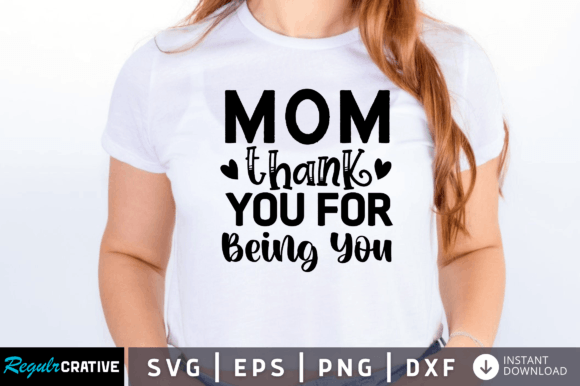
Mom Thank You for Being You SVG
A Designer’s First Look: Warm, Simple, and Sincerely Handmade
When I opened Mom Thank You for Being You SVG, my first thought wasn’t “cute” — it was “comforting.” The layout breathes. Letters are gently rounded, not stiff or overly scripted; there’s no aggressive shadowing or heavy embellishment. It feels like something you’d stitch onto a linen tea towel for your mom’s birthday — quiet, intentional, and emotionally grounded. As a designer who evaluates hundreds of embroidery files each year, I appreciate how rare it is to find a phrase-based design that avoids cliché while still landing with sincerity. This isn’t flashy. It’s warm. And that warmth translates directly into real-world appeal for handmade products.
Where It Shines: Real Projects That Feel Personal
Last week, I prepped a custom embroidered tote bag for a local boutique’s Mother’s Day collection — soft canvas, natural dye, minimalist branding. I tested Mom Thank You for Being You SVG centered on the front panel. Stitched in matte cotton thread (ecru on oat), it held its shape beautifully. No distortion, no skipped stitches, even across the slight curve of the seam allowance. It worked just as well on a lightweight sweatshirt — the letter spacing gave enough breathing room for fill stitch to settle without puffing, and the lowercase “y” and “u” didn’t collapse under dense satin stitching.
I also used it on a set of baby onesies — tiny 3.5-inch hoop version — and it retained legibility without looking cramped. For Etsy sellers listing personalized gifts, this matters: customers scroll fast, but they pause for authenticity. Mom Thank You for Being You SVG reads as handmade, not mass-produced. That perception lifts perceived value — especially on items like pillow covers, aprons, or kitchen towels where the sentiment anchors the whole piece.
Where to Pause Before Pressing Start
It’s not magic on every surface. On highly textured fabrics — think bouclé knit or thick terry cloth — some fine interior curves softened slightly during stitching. Not a dealbreaker, but worth noting if you’re planning a line of embroidered caps or structured patchwork bags. Likewise, on dark fabric, the lack of bold outline or shadow means contrast relies entirely on your thread choice. Test it in black-and-white mockups first. If you’re layering it over another design (say, a floral frame or monogram), check whether the original file includes clean cutlines — since it’s labeled a Graphics file, confirm it converts cleanly to an embroidery file with proper stitch mapping before digitizing.
Also keep hoop size in mind. While scalable, shrinking Mom Thank You for Being You SVG below 2.75 inches risks losing clarity in the lowercase descenders. On stretchy knits or thin rayon blends, use medium-weight cutaway stabilizer — not just tear-away — to prevent puckering around the longer horizontal strokes (“M,” “W,” “o”). And avoid placing it near high-wear seams or curved areas like hat brims unless you’ve verified stitch density won’t cause stiffness or cracking after repeated washing.
Why Craft Business Owners Should Trust This Design
For small shop owners and Etsy sellers, Mom Thank You for Being You SVG checks several quiet-but-critical boxes: it’s versatile enough for multiple product categories (tote bags, sweatshirts, baby items, holiday gifts), emotionally resonant without being saccharine, and simple enough to stitch reliably across machines and skill levels. That reliability builds customer trust — fewer returns, fewer “stitching didn’t match photo” messages. It also supports brand consistency: pair it with neutral thread palettes and natural fiber bases, and it becomes part of a cohesive handmade aesthetic, not just a one-off graphic.
I’ve seen too many craft businesses lose momentum because their digital embroidery files look great on screen but fall apart in production — fuzzy edges, tangled underlay, inconsistent letter weight. Mom Thank You for Being You SVG avoids those pitfalls. Its rhythm feels hand-drawn but engineered for execution. That balance is why it works equally well as a standalone embroidered patch or as part of a larger composition — say, stitched beside a small floral motif on a nursery pillow cover.
Practical Notes Every Embroidery Designer Should Run Through
- Always test on scrap fabric first — especially if using textured, dark, or stretchy materials.
- Check thread color contrast before finalizing — what reads softly on white may vanish on navy.
- Review stitch density in your embroidery software; adjust if needed for delicate fabrics or tight hoops.
- Confirm hoop size compatibility — don’t assume scalability means it’ll auto-fit your smallest hoop.
- Inspect small details like inner loops in “e” and “a”; these can vanish if digitized poorly.
- Test black-and-white and light/dark background mockups to assess visual hierarchy.
- Use appropriate stabilizer: cutaway for knits, tear-away for stable wovens, fusible for lightweight linens.
- Verify licensing before selling finished products or reselling the digital embroidery file — this is a Crafts-category Graphics file, so commercial use terms must be confirmed directly with the source.
Final Thought: A Quiet Design With Real Weight
Mom Thank You for Being You SVG doesn’t shout. It settles. That’s its strength — and why it fits so naturally into thoughtful embroidery projects: a gift-stitched tea towel, a boutique sweatshirt, a baby blanket corner, a holiday card sewn into fabric. It’s the kind of machine embroidery design that makes customers say, “This feels made *for* her,” not “This feels made *with* her in mind.” As a designer and reviewer, I don’t reach for it when I need drama. I reach for it when I need heart — clearly, cleanly, and stitchably delivered.