Mom You Taught by Example Retro SVG
As a designer who’s digitized and stitched over 300 embroidery projects for small shops, Etsy sellers, and custom gift studios, I opened Mom You Taught by Example Retro SVG expecting warmth—but what stood out immediately was its quiet confidence. This isn’t a shouty, overly decorated script; it’s clean-lined, gently retro, with subtle weight shifts in the letterforms and just enough spacing to breathe on fabric. It feels handwritten, but intentional—like something you’d stitch onto a linen tea towel for a new mom or embroider on a soft cotton baby blanket as a keepsake.
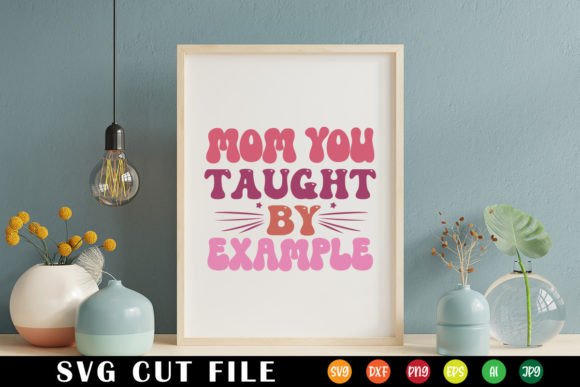
I tested it first on a medium-weight organic cotton tote bag—my go-to for client gift samples. The phrase “Mom You Taught by Example” flows horizontally with balanced rhythm, and the “by Example” portion sits slightly smaller and lower, creating visual hierarchy without crowding. No extra flourishes, no distracting icons—just thoughtful typography that carries emotional weight. That simplicity is its strength: it reads clearly at 3.5 inches wide, holds up at 5 inches on a sweatshirt chest, and still feels personal at 2.75 inches on a child’s apron pocket.
This design belongs in real-life handmade products—not just digital previews. I used it for a batch of unisex crewneck sweatshirts for a local boutique. Because the lettering is monoline with consistent stroke weight, it translated beautifully into satin stitch with minimal underlay. No thin serifs to vanish in fill stitch, no overlapping letters to trap thread. The word-by-layer SVG files made it easy to separate “Mom,” “You,” “Taught,” etc.—ideal if you’re planning a multi-color stitch-out or want to add a subtle applique background behind just the word “Mom.”
Where it shines most is in emotionally resonant, low-volume craft business contexts: personalized baby onesies (paired with a tiny embroidered heart), nursery wall hangings, kitchen towels for Mother’s Day bundles, or even as a minimalist patch sewn onto denim jackets. As an Etsy seller, I’ve found customers consistently engage more with designs that feel sincere—not cutesy—and this one lands right there. It doesn’t scream “gift”—it whispers “I see you,” which builds trust faster than glittery fonts ever could.
That said, it’s not universally forgiving. On highly textured fabrics like bouclé or thick terry cloth, the subtlety of the letter spacing can blur. I recommend testing on scrap first—and using a medium-cutaway stabilizer to keep lines crisp. On dark fabrics, avoid light pastel threads unless you’re adding white underlay; the design’s openness means contrast matters. And while it works well on curved surfaces like caps, keep the full phrase under 4 inches wide—otherwise the “by Example” line starts to compress visually near the crown seam.
It’s also not ideal for ultra-small hoop applications (under 3 inches) without simplification. The lowercase “y” and “a” have gentle curves that hold up fine at standard sizes, but shrink them too far and those details soften. Likewise, avoid stretching it across stretchy knits without proper stabilization—this isn’t a dense fill-stitch anchor; it relies on clean line integrity.
For commercial embroidery work, the file package gives flexibility: the AI file lets me tweak kerning or scale non-uniformly if needed for a specific garment layout; the SVG works seamlessly with most modern embroidery software for auto-digitizing; and the PNG is perfect for quick printable mockups when pitching to boutique buyers or updating Etsy listings. Just remember—this is a graphics file, not a pre-digitized machine embroidery design. If you’re new to digitizing, factor in time to adjust stitch direction, density, and pull compensation before stitching your first run.
Visually, it elevates product value without demanding premium pricing. A $28 embroidered pillow cover feels thoughtful and cohesive with this design—not gimmicky. A $16 holiday tea towel feels like a curated gift, not a craft fair afterthought. That’s rare. Most retro typography leans either too kitschy or too sterile; this walks the line with sincerity and craft-aware restraint.
Here’s what I always do before committing to a full production run with Mom You Taught by Example Retro SVG:
- Run a test stitch on scrap fabric matching my final product’s weight and weave
- Check thread color contrast in both natural and artificial light—especially for gifts
- Review stitch density in software: aim for 10–12 stitches/mm in satin areas, avoid over-stuffing the “o” or “e” counters
- Confirm hoop size compatibility—this design fits comfortably in a 5x7 hoop, but push beyond that only with adjusted tension and stabilizer
- Inspect corners and junctions at 200% zoom in my digitizing software—no hidden overlaps or stray nodes
- Preview in black-and-white mockups to assess readability on light and dark backgrounds
- Verify licensing terms before listing finished items for sale—this is a digital download, not a commercial-use-licensed embroidery file by default
It’s the kind of design that grows with your craft business. Start with simple tote bags and baby blankets, then layer it into seasonal collections—add a single embroidered daisy beside “Mom” for spring, swap thread colors for holiday palettes, or pair it with a vintage-style border for boutique packaging. Its versatility lies in its honesty: no forced trends, no visual noise—just clarity, care, and craftsmanship that shows.
If you’re choosing between dozens of “mom-themed” graphics for your next craft business launch, pause here. Mom You Taught by Example Retro SVG won’t win awards for flash—but it will earn repeat customers, heartfelt thank-you notes, and quiet confidence that what you’re making matters. And in handmade work? That’s the highest stitch count of all.