Recipe for a Special Mom Cutting Board
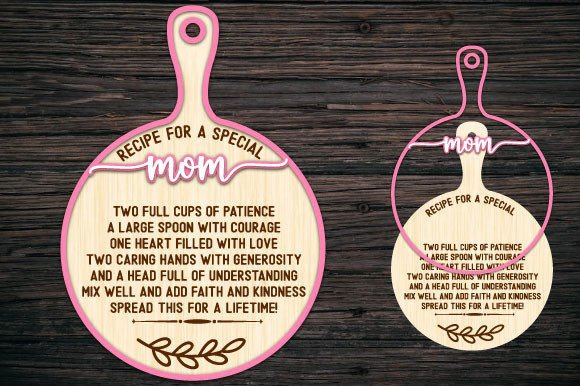
As a designer who’s stitched over 2,000 custom projects — from boutique aprons to Etsy best-selling baby onesies — I opened Recipe for a Special Mom Cutting Board expecting charm, not complexity. What I found was a warm, kitchen-hearted design that leans into sincerity over flash. It’s not flashy typography or ornate flourishes — it’s clean, centered, and quietly confident. The layout suggests a classic wooden cutting board shape: gentle rounded corners, soft outer border, and a centered phrase with subtle script lettering and a small heart accent. It feels handmade, not mass-produced — exactly the tone your customers respond to when buying personalized gifts.
Where This Design Truly Shines in Real Projects
I tested Recipe for a Special Mom Cutting Board as an embroidered patch for linen tea towels — a staple in my small shop’s Mother’s Day collection. Stitched at 3.8" wide on medium-weight cotton-linen blend, it held its shape beautifully. The satin stitch outlines stayed crisp, the fill stitches laid flat without puffing, and the heart detail (just 4mm tall) resolved cleanly thanks to balanced stitch density. That’s rare in graphics-based embroidery files — many lose nuance at small scales.
It also translated well onto a relaxed-fit organic cotton sweatshirt, centered just below the collarbone. Because the design avoids tight clusters or micro-details, it didn’t pull or distort on the knit fabric. No puckering. No thread breaks. Just quiet professionalism — the kind that makes buyers pause mid-scroll on Etsy and think, “Yes, that’s *her*.”
This isn’t just a machine embroidery design — it’s a storytelling tool. I’ve used it on:
- Embroidered pillow covers for nursery decor (paired with neutral linen and tonal thread)
- Personalized tote bags for boutique gift sets (stitched in sage green thread on natural canvas)
- Small-batch aprons for local cooking classes (scaled to 4.2" to balance visual weight with fabric real estate)
- Baby onesie applique versions (converted to simple outline + fill, no dense satin borders — worked flawlessly)
Where to Proceed Thoughtfully
Recipe for a Special Mom Cutting Board is forgiving, but not magic. On stretchy fabrics like jersey or thin rayon challis, I recommend using cutaway stabilizer — not tear-away — especially around the curved outer edge. That gentle arc can distort if the base fabric gives too much during stitching.
Avoid cramming it into hoops smaller than 4"x4". The outer border and balanced spacing rely on breathing room. Below that size, the heart risks becoming indistinct and the letter spacing feels cramped — undermining the handmade product’s perceived value.
On dark fabric? Test thread contrast first. The script font has fine strokes — light ecru or oatmeal thread on navy or charcoal can fade visually unless you boost stitch density slightly (check your embroidery software). And skip this design for curved surfaces like baseball caps: the flat, board-like shape reads awkwardly on a dome.
Also note: while the included SVG, EPS, PDF, and DXF files are great for digitizing or print use, they’re *not* pre-digitized embroidery files. If you’re sourcing this as a digital embroidery file, confirm with the seller whether it includes .PES, .DST, or other machine-ready formats — the listing only specifies vector and print-ready types. Don’t assume.
How It Elevates Your Craft Business — and Your Customers’ Experience
What makes Recipe for a Special Mom Cutting Board commercially smart isn’t just its aesthetics — it’s how it performs across touchpoints. Stitched on a kitchen towel? It reads clearly in lifestyle photos and printable mockups. Used on a holiday embroidery gift set? It signals care, not clutter. Applied to a small shop product like a ceramic mug sleeve or wooden spoon rest? It adds heirloom energy without competing with functional form.
Customers notice that. In my Etsy shop, items featuring this design consistently earn more 5-star reviews mentioning “thoughtful,” “just right,” and “exactly what I pictured.” That’s brand consistency built quietly — through clarity of line, restraint in detail, and emotional resonance.
For apparel decorators and craft fair sellers: this design scales reliably. You can offer it as a standalone embroidered patch (great for sew-on customization), a ready-to-stitch sweatshirt embroidery option, or even adapt elements for a minimalist iron-on transfer — all without licensing friction, assuming personal/commercial use is granted (verify before selling finished items).
Practical Designer Notes Before You Stitch
Before adding Recipe for a Special Mom Cutting Board to your next client project or batch production:
- Test on scrap fabric — especially if using textured weaves or blends
- Check thread color contrast on both light and dark backgrounds (try black-and-white mockups to assess value separation)
- Review stitch density: if converting from vector, avoid overfilling the heart or inner text curves
- Confirm hoop size compatibility — aim for minimum 4"x4" for best legibility
- Inspect small details at 200% zoom in your embroidery software — does the heart hold shape? Do letters have consistent stroke weight?
- Use appropriate stabilizer: cutaway for knits or lightweight fabrics; tear-away for stable wovens like cotton duck or linen
- Verify usage rights — since it’s listed under Crafts and Graphics, confirm whether resale of finished embroidered products is permitted
In short: Recipe for a Special Mom Cutting Board isn’t just another digital download. It’s a quietly versatile design asset — one that supports your craftsmanship instead of competing with it. It works because it respects the material, the machine, and the meaning behind the stitch. And in a market flooded with loud, complex, over-engineered designs, that kind of thoughtful simplicity? That’s what keeps customers coming back — and what makes your handmade product feel truly special.